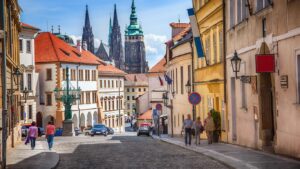
MUSLIM HUNGARY
Islam in Hungary has a long history that dates back to at least the 10th century. The influence of Islam was especially pronounced in the 16th century during the Ottoman period in Hungary.

Early History
In the old form of the Hungarian language, Muslims were called Böszörmény, cognates with Turkish Bozulmamış, which in turn descends from Arabic: مسلم, Muslim, a term preserved as both a family name, and as that of the town Hajdúböszörmény.
The first Islamic author to speak of this Muslim community was Yaqut al-Hamawi (575-626 AH/1179-1229 CE), he writes about a famous Hungarian student who studied in Aleppo, according to the student there were 30 Muslim villages in Hungary. Yaqut writes in his famous geographical dictionary, "Mu'ajam al-Buldan", about his meeting with a Hungarian Muslim youth in Syria who was studying Islam there and brought some details of the history and life of their people in Hungary.
The Andalusian Muslim traveler Abu Hamid al Garnati wrote of two types of Muslims in Hungary, the first being the Böszörmény of the Carpathian Basin and Volga Bulgars (Khwarezmians).
In the 11th century, St. Ladislaus and later Coloman passed laws against the non-Christians (Synod of Szabolcs).
These laws subdued Islam by forcing Muslims to eat pork, go to Church, intermarry, and to forbid them from celebrating Friday prayers. Some of Coloman's laws include :
- If someone catches Muslims in fasting or eating or on keeping away from pork or in ritual washing or in other false practices these Muslims have to be sent to the king and whoever sued them shall receive a share from their properties.
- We command all Muslim villages to build a church and finance it. After the church is built the half village should move and settle elsewhere in order to become similar to us in living together and also in Christ and in Church (i.e. become similar in faith).
- Muslims should not marry their daughters to their nation but only to our nation.
- If an Muslim has a guest, or he invites someone to his house to eat, he and his guests should all eat only pork.
László (Saint Ladislaus) passed the following law :
- On the merchants called Muslims, if it becomes evident from them then after their baptism they return their old laws based on circumcision they should leave their homes but if they prove innocent they should stay.
These laws discriminated severely against the small minority and eventually led to the disappearance of the community and its professions altogether.
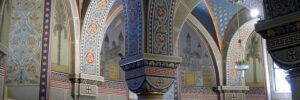
Ottoman Empire conquest of central Hungary
The Ottoman Empire entered Hungary after the Battle of Mohács in 1526. From 1541, they started to control the central part directly and organized five eyalets: Budin, Kanije, Eğri, Varat (Oradea), and Temeşvar.
Ottoman rule in the Hungarian lands ended definitively in 1699, with the signing of the Treaty of Karlowitz. The 150-year Ottoman period left behind a legacy of Islamic architecture such as mosques, türbes, and public baths (hamams), as well as changes in the local cuisine, such as the popularization of coffeehouses and the introduction of the paprika, an essential spice in Hungarian dishes.

Sayiduna Gül Baba
Sayiduna Gül Baba (died 1541), also known as Jafer, was an Ottoman Bektashi dervish poet and companion of Sultan Suleiman the Magnificent who took part in a number of campaigns in Europe from the reign of Mehmed II onwards.
A native of Merzifon (Marsiwān, in the vilāyet of Sivas, Anatolia), he was the son of Kutb’ül Arifin Veli’üddin İbn Yalınkılıç. In Hungary, Gül Baba is known as the "Father of Roses," a literal translation of the meaning of his names in Turkish; he is said to have introduced the flower to the country. However, this is likely a misunderstanding of the metaphorical meaning of the Turkish name, which referred to the dervish's status derived from his deep mystical knowledge of Allah. Roses, wild and domesticated, were already in Hungary by the time of the Ottoman invasion. The name could also be a corruption of Kel Baba, meaning "Bald Father".
Gül Baba is thought to have died in Buda during the first Muslim religious ceremony held after the Ottoman victory of 1541, or alternatively to have been killed during fighting below the walls of the city on August 21, 1541. Suleiman, who was also Caliph, declared him patron saint of the city and is reputed to have been one of the coffin bearers. Gül Baba's descendants are the Marzioglu family, some of whom were the pashas of the Trebizond Vilayet.
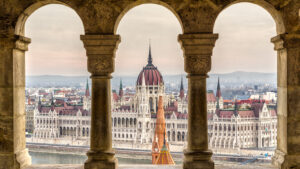
Tomb / Maqaam
Gül Baba's octagonal tomb (türbe) is located on Mecset (mosque) Street, Budapest, a short but steep walk from the Margaret Bridge in the district of Rózsadomb. It was built by Ottoman authorities in Hungary between 1543 and 1548, on the orders of the third pasha of Buda, and has a shallow dome covered with lead plates and wooden tiles. It was left undamaged when the Habsburg armies captured the area during the Second Battle of Buda in 1686, but was converted into a Roman Catholic chapel by the Jesuits, who renamed it "St Joseph's Chapel".
The land later came under the ownership of János Wagner, who maintained the site and allowed access to Muslim pilgrims coming from the Ottoman Empire (see Islam in Hungary). In 1885, the Ottoman government commissioned a Hungarian engineer to restore the tomb and, when work was completed in 1914, it was declared a national monument. The site was restored again in the 1960s and in the 1990s and is now the property of the Republic of Turkey. A large-scale renovation was completed in October 2018, when the site was inaugurated by Hungarian prime minister Viktor Orbán and Turkish president Recep Tayyip Erdoğan.

Eger Mosque Minaret
The Eger minaret (Hungarian: Egri minaret or Kethüda-minaret) is an Ottoman era minaret tower located in Eger city, northern Hungary. It is one of the most northern minarets left from Ottoman rule in Europe. The minaret is 40 metres (131 feet) high and built from red sandstone. It was built in the early 17th century as part of the Djami of Kethuda mosque and used for the Muslim call to prayer (Adhan). The mosque no longer exists, but the minaret survives as a preserved monument of Hungary and a major tourist attraction of Eger. There are 98 steps on the spiral staircase inside, which leads to a balcony at 26 meters from the ground offering unique views of the surrounding city.
Eger minaret is one of three surviving Ottoman era minarets in Hungary. It is the highest and the best preserved of them. The other two minarets are the Érd minaret and the minaret of Yakovalı Hasan Paşa Mosque in Pécs.] In 2016, a Turkish Muslim resident of Eger was permitted to call the Muslim prayer from the minaret balcony after 327 years.
When exactly the minaret was constructed is still unknown and a number of theories exist about it. The Ottomans took control of Eger city in 1596. Eger minaret is believed to have been built at the beginning of Ottoman rule in the early 17th century.
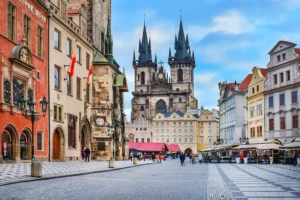
Djami of Kethuda Mosque
The Eger minaret was built as a minaret of the Djami of Kethuda Mosque to call out the Islamic call to prayer five times a day for the faithful to come for congregational prayers. The mosque has been mentioned by Evliya Çelebi, who visited Eger in 1664 when it was under Ottoman rule.
The Ottomans were driven out of Eger in 1687 by an Austrian Imperial Army led by Charles of Lorraine. The mosque was converted into a Catholic church dedicated to St. Joseph after the Ottoman rule. In 1726, the mosque premises were transformed into the Brothers of Mercy Hospital. The mosque served as the chapel of the hospital and the monastery. The mosque building was finally pulled down in 1841, and was replaced by the present St. Sebestyén's Martyrs' Church of Eger. The minaret was entered through the mosque and evidence on the minaret still indicates where it joined the Mosque.
Not much details are known about the Mosque during Ottoman time except for the brief note by Evliya Çelebi. However a more detailed description of the mosque can be constructed from later writings, after its conversion into a St. Joseph church. Gorove and later Ferenc Mészáros have left some descriptions of the former mosque building, when it was a church, along with the minaret. According to these, the mosque had a regular square plan except for a few minor architectural details. It was a meticulously assembled Turkish structure built in stone with carved windows and doors. It was made of the same reddish sandstone as the minaret and covered by a vaulted roof or dome according to Gorove. The main facade of the mosque had a courtyard surrounded by polished stone. The minaret formed an integral part of the mosque according to Ferenc Mészáros description.
Minaret Demolition Attempt
After Ottoman rule ended, an attempt was made to tear down the tower as a symbolic closure of the past. After human force failed, an attempt was made to pull it down using 400 oxen with ropes fixed to the structure. When the tower subhana Allah by the Divine's will proved too resilient to demolition efforts it was allowed to remain after placing a cross on top of the surmounting crescent. The Eger minaret is the only minaret remaining of an estimated 17 that were built in Eger during the 91-year Ottoman rule of the city. A 17th-century illustration of the city shows the abundance of minarets.
In the early 19th century the minarets roof, called the original dome, had collapsed as a result of a lightning strike. It deteriorated the condition of the tower. In 1829, a tin roof was placed on the tower by Archbishop Pyrker János László, preserving it from complete destruction. In 1897, restoration work was carried out on the minaret by the National Committee of the Monuments according to plans of István Möller. The National Monumentary Inspectorate again carried out some minor conservation work in 1962.
In the past, the minaret was seen as a symbol of occupation. Today, it is a celebrated monument of the good relations between Hungary and Turkey.
In 2016, a Turkish national named Demir Hikmet was permitted to become the muezzin (Caller) of the minaret and perform the Adhan or Muslim call to prayer after 327 years. Demir Hikmet climbed the tower three times a week in a silk caftan and recited the call to prayer from the tower balcony.
The minaret was renovated again in 2018 due to deterioration in recent years which had greatly reduced its load-bearing capacity and placed the monument in danger. It was closed for visitors during the renovation and opened again in Summer 2018. During the renovation experts had found ceramic dishes dating back to the Turkish era.