
MUSLIM GREECE
THE RISE OF ISLAM IN GREECE
Most people know that the Parthenon in Athens was a pagan temple. Fewer know that it was also, at one time, a great Mosque.
The Mosque was built many centuries ago—after the Ottoman Turks carried the banner of Islam into Greece in 1354. And although some old prints show a minaret rising from one corner of the Parthenon there is only one trace of the Mosque left today: a rough staircase inside the ruins.
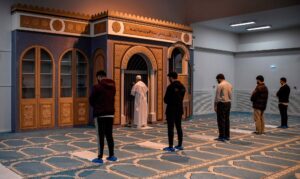
But that's the Parthenon. Elsewhere in Greece—in eastern Macedonia and particularly in Thrace—the stamp of Islam is plainly visible in the minarets and the soaring cry of the muezzin calling the faithful to prayer five times a day.
Islam came to Greece at the invitation of the Byzantine Empire. Although initially a mortal enemy of the Byzantines, the Muslims agreed to help Byzantium tame the troublesome Serbs—and stayed five and a half centuries. Even as late as 1913 Muslims formed nearly 40 percent of the population of Macedonia. Ten years later, however, when the First World War's Treaty of Lausanne rearranged frontiers and populations, nearly 350,000 Greek Muslims had to leave in exchange for nearly 600,000 Greek Orthodox Christians living elsewhere. When the exchange was completed the Muslim presence was reduced to those living in Thrace, an enclave that today numbers about 108,000 Muslims.
Thrace is a region of great natural beauty, with the sharp peaks and steep ridges of the Rodopi range interspersed with little valleys and the Drama-Serres plain. It is also a prosperous region that grows cotton, cereals and, in the foothills around Kavala, Xanthi, Drama and Komotini, tobacco—Greece's major earner of foreign exchange. There are six principal varieties of the leaf: Basma, Bachi Bagli, Kaba Koulak, Trebezonde, Samsoun and Smyrna. As the names imply, the last three were brought in by the refugees of Asia Minor in 1923.
In the villages and towns of the lowlands the Muslims all speak Turkish, and in some outlying villages not a person can be found who understands Greek. But in the towns they are usually bilingual and freely intermingle with their Greek Orthodox neighbors. Children play together, mothers compare baby formulas on the street corner and both Muslim and Christian men retire to all-male tavernas for the evening. They play backgammon, twirl worry beads and sip sweet coffee.
In the highlands and mountains live a completely different group of Greek Muslims: the Pomaks, a Serbian-speaking people from Bulgaria. The Pomaks are Slavs who accepted Islam after exposure to the Ottomans. Their name is generally believed to derive from pomagaci, or "helper," for they often served as auxiliary troops for the Turks after their conversion in the 14th century.
But let us go back to the beginning...Crete had been raided by Muslim forces since the first wave of the Muslim conquests in the mid-7th century. It first experienced a raid in 654 and then another in 674/675, and parts of the island were temporarily occupied during the reign of the Umayyad Caliph Al-Walid I (r. 705–715). However, the island at that time was not conquered and despite occasional raids in the 8th century, it remained securely in Byzantine hands; Crete was too far from the Arab naval bases in the Levant for an effective expedition to be undertaken against it.
Emirate of Crete
The Emirate of Crete , romanized: Iqrīṭish or إقريطية, Iqrīṭiya; Greek: Κρήτη, romanized: Krētē) was an Islamic state that existed on the Mediterranean island of Crete from the late 820s to the reconquest of the island by the Byzantine Empire in 961. Although the emirate recognized the suzerainty of the Abbasid Caliphate and maintained close ties with Tulunid Egypt, it was de facto independent.
A group of Andalusian exiles led by Abu Hafs Umar al-Iqritishi conquered Crete in either 824 or 827/828, and established an independent Islamic state. The Byzantines launched a campaign that took most of the island back in 842-43 under Theoktistos, but the reconquest was not completed and would soon be reversed. Later attempts by the Byzantine Empire to recover the island failed, and for the approximately 135 years of its existence, the emirate was one of the major foes of Byzantium. Crete commanded the sea lanes of the Eastern Mediterranean and functioned as a forward base and haven for Muslim corsair fleets that ravaged the Byzantine-controlled shores of the Aegean Sea. The emirate's internal history is less well known, but all accounts point to considerable prosperity deriving not only from piracy but also from extensive trade and agriculture. The emirate was brought to an end by Nikephoros Phokas, who successfully campaigned against it in 960–961.
At some point in the second half of the reign of Byzantine Emperor Michael II (r. 820–829), a group of Andalusian exiles landed on Crete and began its conquest. These exiles had a long nomadic history. Traditionally they have been described as the survivors of a failed revolt against the Emir al-Hakam I of Córdoba in 818. In the aftermath of its suppression, the citizens of the Córdoban suburb of al-Rabad were exiled en masse. Some settled in Fez in Morocco, but others, numbering over 10,000, took to piracy, probably joined by other Andalusians, landed in Alexandria and took control of the city until 827, when they were besieged and expelled by the Abbasid general Abdullah ibn Tahir al-Khurasani. As W. Kubiak points out, however, the supposed origin from Córdoba is contradicted by other sources, which record the presence of Andalusian corsairs in Alexandria as early as 798/9, and their takeover is dated to 814; furthermore, the Andalusians' leader, Umar ibn Hafs ibn Shuayb ibn Isa al-Balluti, commonly known as Abu Hafs, came from a locality (Fahs al-Ballut) that was far from Córdoba.
The exact chronology of the Andalusians' landing in Crete is uncertain. Following the Muslim sources, it is usually dated to 827 or 828, after the Andalusians' expulsion from Alexandria. Byzantine sources however seem to contradict this, placing their landing soon after the suppression of the large revolt of Thomas the Slav (821–823). Further considerations regarding the number and chronology of the Byzantine campaigns launched against the invaders and prosopographical questions of the Byzantine generals that headed them have led other scholars like Vassilios Christides and Christos Makrypoulias to propose an earlier date, c. 824. Under the terms of their agreement with Ibn Tahir, the Andalusians and their families left Alexandria in 40 ships. Historian Warren Treadgold estimates them at some 12,000 people, of whom about 3,000 would be fighting men. According to Byzantine historians, the Andalusians were already familiar with Crete, having raided it in the past. They also claim that the Muslim landing was initially intended as a raid, and was transformed into a bid for conquest when Abu Hafs himself set fire to their ships. However, as the Andalusian exiles had brought their families along, this is probably a later invention. The Andalusians' landing-place is also unknown; some scholars think that it was at the north coast, at Suda Bay or near where their main city and fortress Chandax (Arabic: ربض الخندق, rabḍ al-kḫandaq, "Castle of the Moat", modern Heraklion) was later built, but others think that they most likely landed on the south coast of the island and then moved to the more densely populated interior and the northern coast.
As soon as Emperor Michael II learned of the Arab landing, and before the Andalusians had secured their control over the entire island, he reacted and sent successive expeditions to recover the island. Losses suffered during the revolt of Thomas the Slav hampered Byzantium's ability to respond, however, and if the landing occurred in 827/828, the diversion of ships and men to counter the gradual conquest of Sicily by the Tunisian Aghlabids also interfered. The first expedition, under Photeinos, strategos of the Anatolic Theme, and Damian, Count of the Stable, was defeated in open battle, where Damian was killed. The next expedition was sent a year later and comprised 70 ships under the strategos of the Cibyrrhaeots Krateros. It was initially victorious, but the overconfident Byzantines were then routed in a night attack. Krateros managed to flee to Kos, but there he was captured by the Arabs and crucified. Makrypoulias suggests that these campaigns must have taken place before the Andalusians completed their construction of Chandax, where they transferred the capital from the inland site of Gortyn.
The Pirate Island
Abu Hafs repulsed the early Byzantine attacks and slowly consolidated control of the entire island. He recognized the suzerainty of the Abbasid Caliphate, but he ruled as a de facto independent Emir . The conquest of the island was of major importance as it transformed the naval balance of power in the Eastern Mediterranean and opened the hitherto secure Aegean Sea littoral to frequent and devastating raids.
The Andalusians also occupied several of the Cyclades during these early years, but Michael II organized another large-scale expedition, recruiting an entire new marine corps, the Tessarakontarioi, and building new ships. Under the admiral Ooryphas, this fleet managed to evict the Arabs from the Aegean islands but failed to retake Crete. Michael II's successor Theophilos (r. 829–842) sent an embassy to Abd ar-Rahman II of Córdoba proposing a joint action against the Andalusian exiles, but beyond Abd ar-Rahman giving his assent to any Byzantine action against Crete, this came to nothing. In October 829, those Arabs destroyed an imperial fleet off Thassos, undoing much of the work of Ooryphas and opening the Aegean and its coasts to pillage. Later they attacked Euboea (c. 835–840), Lesbos (837), and the coasts of the Thracesian Theme, where they destroyed the monastic centre of Mount Latros. They were heavily defeated, however, by the local strategos, Constantine Kontomytes.
After the death of Theophilos in 842, new measures to confront the Cretan threat were undertaken by the new Byzantine regime: in 843 a new maritime theme, that of the Aegean Sea, was established to better deal with the Arab raids, and another expedition to recover Crete was launched under the personal leadership of the powerful logothetes and regent Theoktistos. Although it succeeded in occupying much of the island, Theoktistos had to abandon the army due to political intrigues in Constantinople, and the troops left behind were slaughtered by the Arabs.
In an effort to weaken the Arabs in 853, several Byzantine fleets engaged in coordinated operations in the Eastern Mediterranean, attacking the Egyptian naval base of Damietta and capturing weapons intended for Crete. Despite some Byzantine successes against the Arabs in the following years, the Cretans resumed their raids in the early 860s, attacking the Peloponnese, the Cyclades, and Athos. In 866, the Byzantine Caesar Bardas assembled another large-scale expeditionary force to subdue Crete, but his murder by Basil the Macedonian only two weeks after the fleet set sail from the capital spelled the end of the undertaking.
In the early 870s, the Cretan raids reached a new intensity: their fleets, often commanded by Byzantine renegades, ranged the Aegean and further afield, reaching the Dalmatian coasts. On one occasion c. 873 a Cretan fleet under the renegade Photios even penetrated into the Marmara Sea and unsuccessfully attacked Proconnesos, the first time since the Second Arab Siege of Constantinople in 717–718 that a Muslim fleet had come so close to the Byzantine capital. On its return, however, it suffered a heavy defeat at the hands of the new Byzantine admiral, Niketas Ooryphas, at the Battle of Kardia. Shortly after, Ooryphas once again defeated the Cretans at the Gulf of Corinth and took many prisoners, whom he tortured extensively in revenge for their raids. At about the same time, the Muslim fleet of Tarsus led by Yazaman al-Khadim was destroyed in a raid against Euripos. These Byzantine victories apparently led to a temporary truce, and it appears that the Cretan Emir Saïpes (Shu'ayb ibn Umar) was obliged to pay tribute to Byzantium for about a decade.
Raids resumed soon after, in which the Cretans were joined by North African and Syrian fleets. The Peloponnese in particular suffered considerably from their raids, but also Euboea and the Cyclades: the islands of Patmos, Karpathos and nearby Sokastro came under Cretan control, and Cretan rule extended as far north as Aegina in the Saronic Gulf, and to Elafonisos and Cythera off the southern coast of the Peloponnese; the great Cycladic island of Naxos, probably along with the neighbouring islands of Paros and Ios, was forced to pay them the poll-tax (jizya).
As the Muslim presence left generally few material or literary traces, the list of islands at one time controlled or occupied by them could well be longer. Nevertheless, the impact of this new wave of Arab raids was felt across the Aegean, where some islands were deserted altogether, and elsewhere coastal sites were abandoned for better protected inland locations. Athens may have been occupied in c. 896–902, and in 904, a Syrian fleet led by Leo of Tripoli sacked the Byzantine Empire's second city, Thessalonica. The Arabs of Crete co-operated closely with their Syrian counterparts, who often used Crete as a base or a stop-over, as during the return of Leo of Tripoli's fleet from Thessalonica, when many of the over 20,000 Thessalonian captives were sold or gifted as slaves in Crete. Likewise, the Cretan emirate received strong support from the Tulunid governors of Egypt (868–905), but their Ikhshidid successors neglected aid to Crete. In 911, another large-scale Byzantine expedition of well over 100 ships was launched against Crete, headed by the admiral Himerios, but it was forced to leave the island after a few months. On its return journey, Himerios' fleet was destroyed in battle off Chios by the Syrian fleet.

Byzantine reconquest
Cretan piracy reached another high in the 930s and 940s, devastating southern Greece, Athos, and the western coasts of Asia Minor. As a result, Emperor Constantine VII (r. 913–959) sent another expedition in 949. This too was routed in a surprise attack, a defeat which Byzantine chroniclers ascribe to the incompetence and inexperience of its leader, the eunuch chamberlain Constantine Gongyles. Constantine VII did not give up, and during the last years of his reign he began preparing another expedition. It would be carried out under his successor, Romanos II (r. 959–963), who entrusted its leadership to the capable general Nikephoros Phokas. At the head of a huge fleet and army, Phokas sailed in June or July 960, landed on the island, and defeated the initial Muslim resistance. A long siege of Chandax followed, which dragged over the winter into 961, when the city was stormed on 6 March.The city was pillaged, and its Mosques and walls were torn down. Muslim inhabitants were either killed or carried off into slavery, while the island's last emir Abd al-Aziz ibn Shu'ayb (Kouroupas) and his son al-Numan (Anemas) were taken captive and brought to Constantinople, where Phokas celebrated a triumph. The island was converted into a Byzantine theme, and the remaining Muslims were converted to Christianity by missionaries like Nikon "the Metanoeite". Among the converts was the prince Anemas, who entered Byzantine service and fell at Dorostolon, in the war of 970–971 against the Rus'.This early Muslim period of Crete remains relatively obscure due to a paucity of surviving evidence regarding its internal history. Furthermore, other than a few place names recalling the presence of the Arabs, no major archaeological remains from the period survive, possibly due to deliberate Byzantine destruction after 961. This has influenced the way the emirate is generally regarded: scholars, forced to rely mostly on Byzantine accounts, have traditionally viewed the Emirate of Crete through a Byzantine lens as a quintessential "corsair's nest", surviving on piracy and the slave trade.
The picture painted by the few and scattered references to the Cretan emirate from the Muslim world, on the other hand, is of an ordered state with a regular monetary economy and extensive trade links, and there is evidence that Chandax was a cultural centre of some importance. The survival of numerous gold, silver, and copper coins, of almost constant weight and composition, testifies to a strong economy and a high living standard among the population. The economy was strengthened by extensive trade with the rest of the Muslim world, especially with Egypt, and by a booming agriculture: the need to sustain an independent state, as well as access to the markets of the Muslim world, led to an intensification of cultivation. It is also possible that sugar cane was introduced to Crete at the time.
The Ottoman Empire
After the fall of Constantinople to the Ottomans in 1453, the Despotate of the Morea was the last remnant of the Byzantine Empire to hold out against the Ottomans. However, it fell to the Ottomans in 1460, completing the conquest of mainland Greece.
While most of mainland Greece and the Aegean islands was under Ottoman control by the end of the 15th century, Cyprus and Crete remained Venetian territory and did not fall to the Ottomans until 1571 and 1670 respectively. The only part of the Greek-speaking world that escaped Ottoman rule was the Ionian Islands, which remained Venetian until 1797. Corfu withstood three major sieges in 1537, 1571 and 1716 all of which resulted in the repulsion of the Ottomans.
Other areas that remained part of the Venetian Stato da Màr include Nafplio and Monemvasia until 1540, the Duchy of the Archipelago, centered on the islands of Naxos and Paros until 1579, Sifnos until 1617 and Tinos until 1715.
The consolidation of Ottoman rule was followed by two distinct trends of Greek migration. The first entailed Greek intellectuals, such as Basilios Bessarion, Georgius Plethon Gemistos and Marcos Mousouros, migrating to other parts of Western Europe and influencing the advent of the Renaissance (though the large scale migration of Greeks to other parts of Europe, most notably Italian university cities, began far earlier, following the Crusader capture of Constantinople ). This trend also had an effect on the creation of the modern Greek diaspora.
The second entailed Greeks leaving the plains of the Greek peninsula and resettling in the mountains, where the rugged landscape made it hard for the Ottomans to establish either military or administrative presence.
The Sultan sat at the apex of the government of the Ottoman Empire. Although he had the trappings of an absolute ruler, he was actually bound by tradition and convention. These restrictions imposed by tradition were mainly of a religious nature. Indeed, the Qur'an was the main restriction on absolute rule by the sultan and in this way, the Qur'an served as a "constitution."
Ottoman rule of the provinces was characterized by two main functions. The local administrators within the provinces were to maintain a military establishment and to collect taxes. The military establishment was feudal in character. The Sultan's cavalry were allotted land, either large allotments or small allotments based on the rank of the individual cavalryman. All non-Muslims were forbidden to ride a horse which made traveling more difficult. The Ottomans divided Greece into six sanjaks, each ruled by a Sanjakbey accountable to the Sultan, who established his capital in Constantinople in 1453
The conquered land was parceled out to Ottoman soldiers, who held it as feudal fiefs (timars and ziamets) directly under the Sultan's authority. This land could not be sold or inherited, but reverted to the Sultan's possession when the fief-holder (timariot) died. During their life-times they served as cavalrymen in the Sultan's army, living well on the proceeds of their estates with the land being tilled largely by peasants. Many Ottoman timariots were descended from the pre-Ottoman Christian nobility, and shifted their allegiance to the Ottomans following the conquest of the Balkans. Conversion to Islam was not a requirement, and as late as the fifteenth century many timariots were known to be Christian, although their numbers gradually decreased over time.
The Ottomans basically installed this feudal system right over the top of the existing system of peasant tenure. The peasantry remained in possession of their own land and their tenure over their plot of land remained hereditary and inalienable. Nor was any military service ever imposed on the peasants by the Ottoman government. All non-Muslims were in theory forbidden from carrying arms, but this was ignored. Indeed, in regions such as Crete, almost every man carried arms.
Greek Christian families were, however, subject to a system of brutal forced conscription known as the devshirme. The Ottomans required that male children from Christian peasant villages be conscripted and enrolled in the corps of Janissaries for military training in the Sultan's army. Such recruitment was sporadic, and the proportion of children conscripted varied from region to region. The practice largely came to an end by the middle of the seventeenth century.
Under the Ottoman system of government, Greek society was at the same time fostered and restricted. With one hand the Turkish regime gave privileges and freedom to its subject people; with the other it imposed a tyranny deriving from the malpractices of its administrative personnel over which it exercised only remote and incomplete control. In fact the “rayahs” were downtrodden and exposed to the vagaries of Turkish administration and sometimes to the Greek landlords. The term rayah came to denote an underprivileged, tax-ridden and socially inferior population.
Most of the areas which today are within modern Greece's borders were at some point in the past part of the Ottoman Empire. This period of Ottoman rule in Greece, lasting from the mid-15th century until the successful Greek War of Independence that broke out in 1821 and the proclamation of the First Hellenic Republic in 1822 (preceded by the creation of the autonomous Septinsular Republic in 1800), is known in Greek as Tourkokratia (Greek: Τουρκοκρατία, "Turkish rule"; English: "Turkocracy"). Some regions, however, like the Ionian islands, various temporary Venetian possessions of the Stato da Mar, or Mani peninsula in Peloponnese did not become part of the Ottoman administration, although the latter was under Ottoman suzerainty.
The Eastern Roman Empire, the remnant of the ancient Roman Empire which ruled most of the Greek-speaking world for over 1100 years, had been fatally weakened since the sacking of Constantinople by the Latin Crusaders in 1204.
The Ottoman advance into Greece was preceded by victory over the Serbs to its north. First, the Ottomans won the Battle of Maritsa in 1371. The Serb forces were then led by the King Vukašin of Serbia, the father of Prince Marko and the co-ruler of the last emperor from the Serbian Nemanjic dynasty. This was followed by another Ottoman draw in the 1389 Battle of Kosovo.
With no further threat by the Serbs and the subsequent Byzantine civil wars, the Ottomans besieged and took Constantinople in 1453 and then advanced southwards into Greece, capturing Athens in 1458. The Greeks held out in the Peloponnese until 1460, and the Venetians and Genoese clung to some of the islands, but by the early 16th century all of mainland Greece and most of the Aegean islands were in Ottoman hands, excluding several port cities still held by the Venetians (Nafplio, Monemvasia, Parga and Methone the most important of them). The mountains of Greece were largely untouched, and were a refuge for Greeks who desired to flee Ottoman rule and engage in guerrilla warfare.
The Cyclades islands, in the middle of the Aegean, were officially annexed by the Ottomans in 1579, although they were under vassal status since the 1530s. Cyprus fell in 1571, and the Venetians retained Crete until 1669. The Ionian Islands were never ruled by the Ottomans, with the exception of Kefalonia (from 1479 to 1481 and from 1485 to 1500), and remained under the rule of the Republic of Venice. It was in the Ionian Islands where modern Greek statehood was born, with the creation of the Republic of the Seven Islands in 1800.
Ottoman Greece was a multiethnic society. The Greeks were given privileges and freedom. Despite losing their political independence, the Greeks remained dominant in the fields of commerce and business. The consolidation of Ottoman power in the 15th and 16th centuries rendered the Mediterranean safe for Greek shipping, and Greek shipowners became the maritime carriers of the Empire, making tremendous profits.
This period of Ottoman rule had a profound impact in Greek society, as new elites emerged . The Greek land-owning aristocracy that traditionally dominated the Byzantine Empire suffered a tragic fate, and was almost completely destroyed. The new leading class in Ottoman Greece were the prokritoi (πρόκριτοι in Greek) called kocabaşis by the Ottomans. The Phanariots became prominent in the imperial capital of Constantinople as businessmen and diplomats, and the Greek Orthodox Church and the Ecumenical Patriarch rose to great power under the Sultan's protection.